
UAPA Act 1967: History, Provisions, Amendments & Summary for UPSC Notes
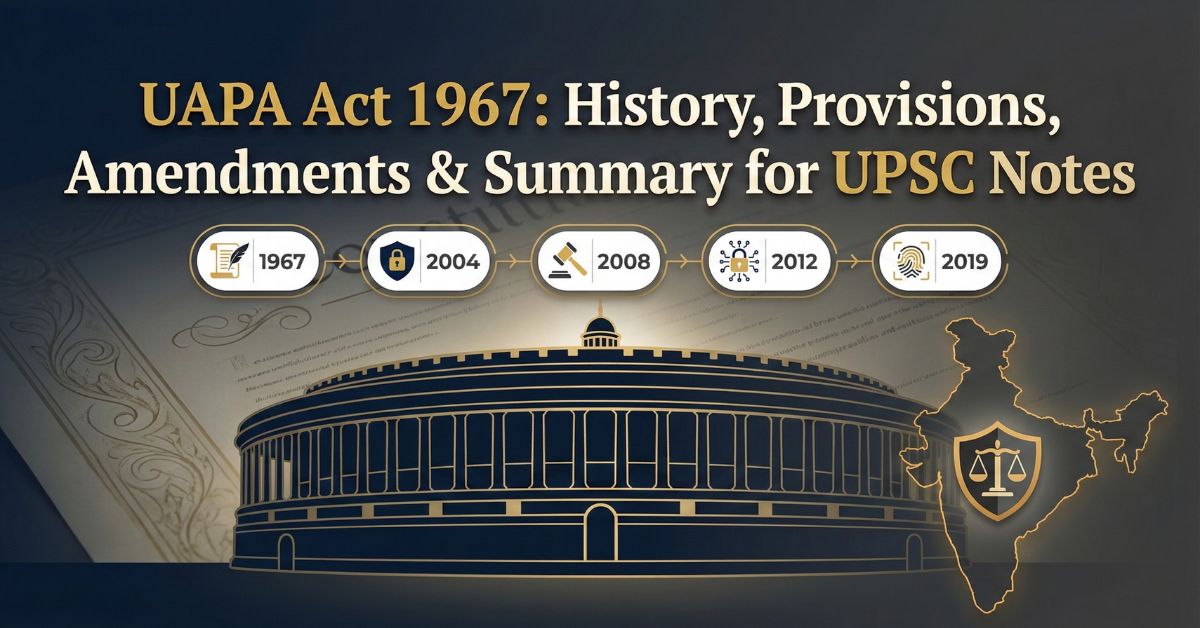
The Unlawful Activities (Prevention) Act (UAPA), 1967 is one of India’s most powerful and controversial national security laws. It is the primary legal framework used by the government to combat terrorism, unlawful activities, and secessionist movements. Over time, several amendments have transformed UAPA from a law aimed at “unlawful associations” into an extensive anti-terror legislation used by central agencies like the National Investigation Agency (NIA).
For UPSC aspirants, the UAPA is crucial for the subjects:
- Indian Polity and Constitution
- Internal Security (GS Paper 3)
- Current Affairs
- Essay Paper (Security vs. Liberty theme)
This expanded guide covers history, objectives, provisions, amendments, concerns, criticism, and UPSC-focused notes, making it a complete resource for quick revision and mains answer writing.
1. Historical Background of UAPA Act 1967
The historical evolution of UAPA revolves around India’s challenges in maintaining territorial integrity shortly after independence.
1.1 Early Post-Independence Context
India witnessed major secessionist movements:
- Naga insurgency in the Northeast
- Dravidian separatist movements in Tamil Nadu
- Left-wing extremist ideologies
- External influence during the Cold War era
These activities required a legal mechanism to control anti-national activities.
1.2 1963 – Committee on National Integration
After rising separatist tendencies, the National Integration Council formed a committee to study:
- Cases threatening national unity
- Measures to curb secession
- Measures to curb secession Strengthening legal provisions
This committee recommended stronger legislation to deal with unlawful activities.
1.3 1967 – Enactment of UAPA
The UAPA Act was introduced to:
- Ban unlawful organizations
- Restrict activities promoting secession
- Control anti-national propaganda
Initially, UAPA was not a full-fledged anti-terror law. Its primary intention was to curb activities affecting sovereignty and integrity.
2. Objectives of the UAPA Act
The UAPA ensures that the government has adequate power to act against individuals or groups posing a threat to national security.
Major Objectives:
- Prevent unlawful activities threatening sovereignty and territorial integrity.
- Deal with terrorism through strict provisions
- Ban organizations & individuals involved in terrorism.
- Regulate foreign funding or support for unlawful activities.
- Provide a legal framework for investigation and prosecution of terror-related cases.
- Strengthen internal security through surveillance, restrictions, and preventive detention.
3. Key Features & Provisions of UAPA Act 1967
The UAPA Act expanded significantly after major amendments and now incorporates powerful anti-terror tools. UPSC aspirants must carefully understand the key provisions.
3.1 Definition of Unlawful Activity (Section 2(o))
An activity is considered unlawful if it:
- Intends to bring cessation or secession from India
- Questions India’s territorial integrity
- Causes disaffection against India
- Disrupts harmony between communities
This broad definition helps the government act proactively against threats.
3.2 Unlawful Association (Section 3)
The Central Government may declare an association unlawful if:
- It supports or encourages unlawful activities
- It poses a threat to national integrity
- It engages in violent or disruptive activities
Such associations can be banned for up to five years, with judicial oversight from a tribunal headed by a High Court judge.
3.3 Definition of a Terrorist Act (Section 15)
A terrorist act includes:
- Use of bombs, firearms, explosives
- Acts meant to threaten the unity, integrity, security, or sovereignty
- Attacks on critical infrastructure
- Causing death, injury, or destruction
- Disruption of essential services (electricity, transport, communication)
Section 15 forms the backbone of UAPA’s terror-related provisions.
3.4 Punishments for Terrorist Activities
- Life imprisonment or death penalty (in specific cases)
- Rigorous imprisonment
- Seizure of property used or intended to be used in terrorism
- Punishment for financing terrorism
- Penal actions for raising funds from foreign or domestic sources
3.5 Declaring Individuals & Organizations as Terrorists (Sections 35 & 36)
Earlier, only organizations could be declared terrorists. After the 2019 amendment, the government can:
- Declare individuals as terrorists
- Publish their name in the Schedule
- Designate any person associated with terrorism even without a conviction
This provision is often debated for its impact on personal liberty.
3.6 Powers of Investigation (NIA & Police)
UAPA gives strong powers to investigation agencies.
Key Powers:
- Detain a suspect up to 180 days without filing a charge sheet
- NIA can take over cases without state approval
- Attachment or seizure of property linked to terrorism
- Arrest without warrant
- Interception of communications
Under Section 43D(5), bail becomes extremely difficult because the court must be satisfied that the accused is not guilty – a very high threshold.
4. Important Amendments to UAPA Act
Over time, amendments have transformed UAPA into India’s most stringent anti-terror law.
4.1 UAPA Amendment 2004
This amendment was passed after the repeal of POTA (Prevention of Terrorism Act).
Key changes:
- Added the concept of “terrorist organization”
- Listed terrorist groups in the First Schedule
- Empowered the government to ban them
- Restricted terrorist funding
4.2 UAPA Amendment 2008 (Post 26/11 Mumbai Attacks)
Strengthened after the biggest terror attack on Indian soil.
Major changes:
- Expanded definition of terrorism
- Allowed longer detention periods
- Set up special fast-track courts
- Gave more powers to NIA under a separate Act
- Allowed evidence from electronic sources (videos, emails, calls)
4.3 UAPA Amendment 2012
The 2012 amendment aligned India’s laws with international anti-terror standards.
New additions:
- Expanded definition of “property” in terror funding
- Included threats to economic security
- Brought in offenses related to counterfeiting currency
- Enhanced freezing and seizure powers
4.4 UAPA Amendment 2019
Perhaps the most debated amendment.
Key provisions:
- The government may declare individuals as terrorists
- NIA officers of the rank of Inspectors can investigate cases
- Property linked to terrorism can be seized without delay
- Enhanced central power over states in terror investigations
This amendment strengthens anti-terror measures but has raised concerns regarding fundamental rights.
5. Criticism, Challenges & Concerns Related to UAPA
UAPA has often been scrutinized for its broad and stringent provisions.
5.1 Stringent Bail Provisions
- Bail under UAPA is extremely rare.
- Section 43D(5) makes it nearly impossible unless prima facie innocence is proved
5.2 Possibility of Misuse
- Often criticized for targeting activists, scholars, journalists, or critics of the government.
- “Terrorist” label without conviction can harm personal liberty and reputation.
5.3 Broad & Vague Definitions
- Terms like “unlawful activity” or “terrorist act” can be interpreted widely.
5.4 Long Detention Without Charge Sheet
- Under UAPA, detention can extend up to 180 days.
- This is longer than ordinary criminal laws.
5.5 Overlap with Sedition Law (Section 124A IPC)
- Both laws deal with speech and expressions questioning the state, increasing concerns of stifling dissent.
6. Supreme Court’s Stand on UAPA
The judiciary has tried to balance national security and fundamental rights.
Key Judgments:
- Zahoor Watali Case (2019): Reinforced strict bail conditions.
- K.A. Najeeb Case (2021): SC allowed bail under Article 21 when trials are excessively delayed.
- NIA vs. A Singh Case:Courts must check if allegations are prima facie true before granting bail.
The SC acknowledges the law’s importance but stresses judicial oversight and reasonable restrictions.
7. UAPA vs Other Anti-Terror Laws in India
| Law | Status | Notes |
|---|---|---|
| TADA (1985–1995) | Repealed | Misuse allegations, mass arrests |
| POTA (2002–2004) | Repealed | Human rights concerns |
| UAPA (1967–Present) | In force | Most comprehensive, longest surviving |
With TADA & POTA repealed, UAPA is now India’s primary anti-terror law.
8. UAPA: Key Points for UPSC Prelims
- Enacted: 1967
- Ministry:Home Affairs
- Key sections:2(o), 3, 15, 35, 43D(5)
- Allows declaring individuals as terrorists (2019)
- NIA can investigate nationwide
- Detention without charge sheet up to 180 days
- Bail is highly restricted
- Offenses include terrorist funding, support, propaganda
9. UAPA: Key Points for UPSC Mains (GS-3)
Include these points in a mains answer:
- Balancing national security & civil liberties
- Misuse concerns vs. need for strict terror laws
- Judicial oversight
- Role of NIA in counter-terror investigations
- International standards (UNSC resolutions, FATF guidelines)
- Effectiveness in preventing terrorism
- Need for clearer definitions and safeguards
10. Short Summary Notes for Last-Minute UPSC Revision
- Purpose: Curb unlawful activities & terrorism
- 2004 Amendment:Added terrorist organizations
- 2008 Amendment:Strengthened after 26/11
- 2012 Amendment: Added economic security
- 2019 Amendment:Declared individuals as terrorists
- Criticism:Misuse, strict bail laws, vague definitions
- Importance for UPSC:GS-2, GS-3, Polity, Security, Prelims
11. Conclusion
The UAPA Act, 1967 is a crucial tool in India’s fight against terrorism. While it strengthens the nation’s security framework, it also sparks debates about constitutional freedoms, judicial safeguards, and human rights. A balanced understanding of its history, provisions, amendments, and controversies is essential for cracking UPSC Prelims and Mains. With national security being a recurring theme in the exam, UAPA remains one of the most important laws for UPSC preparation.