
National Youth Day 2026 – Issues, Challenges & Way Forward
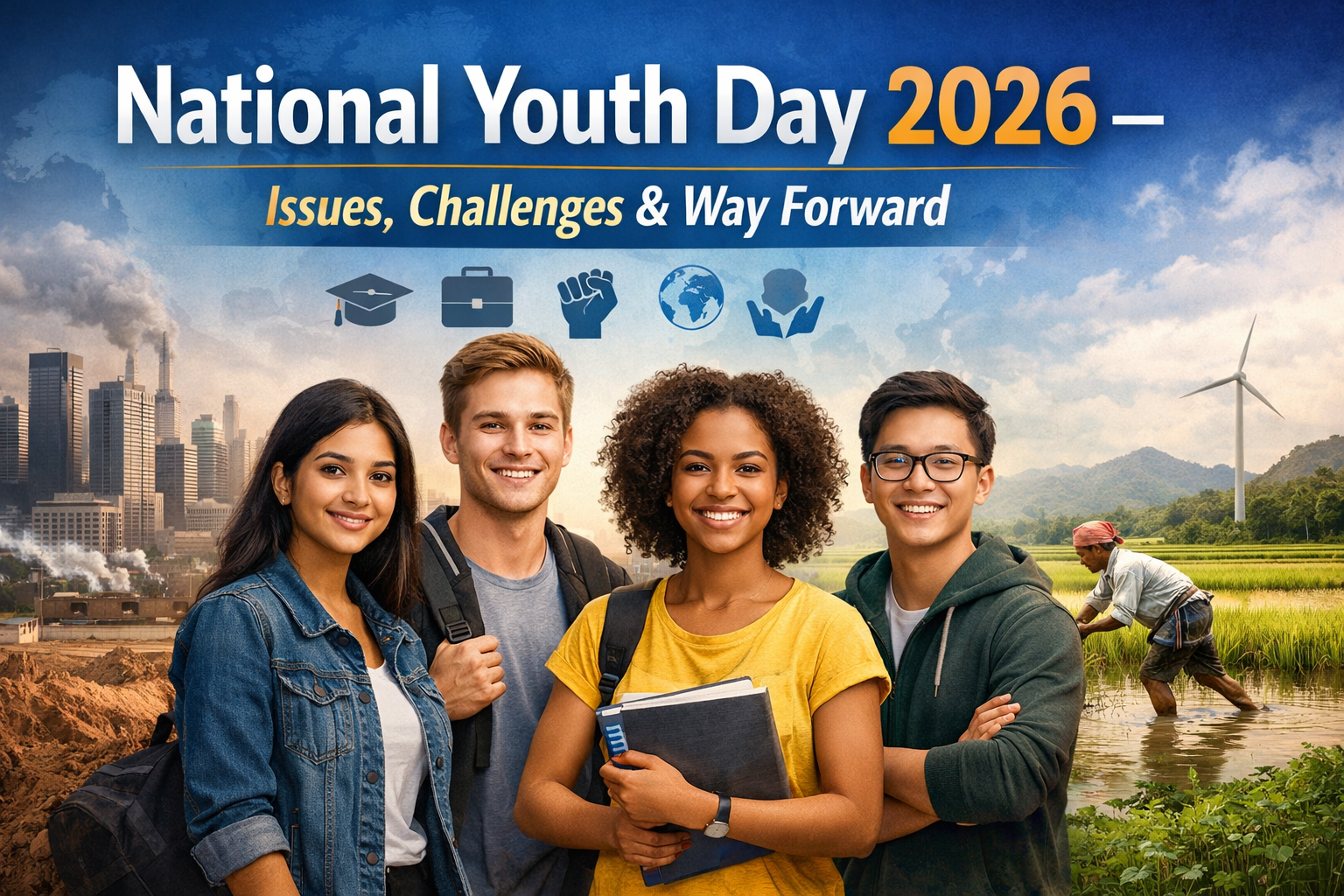
National Youth Day, celebrated every year on January 12, marks the birth anniversary of Swami
Vivekananda, India’s foremost youth icon and spiritual reformer. Declared in 1984, the day aims to
inspire young Indians to build strong character, acquire knowledge, and contribute meaningfully to
society.
India today has the largest youth population in the world, with nearly 65% under the age of 35,
offering a historic opportunity—but also creating unprecedented challenges that demand urgent
attention.
🇮🇳 Why This Topic Matters for UPSC?
- Prelims: Questions on social reformers, government schemes, youth bodies
- GS-I: Demographic dividend, role of youth, social empowerment
- GS-II: Skill development, education, employment, governance
- GS-IV: Values, leadership, ethics from Vivekananda’s teachings
- Essay Paper: Youth, character-building, demographic dividend, national development
About National Youth Day
- Strength of character
- Fearlessness
- Service to humanity
- National integration
- Universal brotherhood
National Youth Day celebrates these ideals through programs in schools, colleges, universities, and youth forums, reminding India’s young population to become self-driven, responsible, and nation-focused individuals.
Major Issues Facing India’s Youth (UPSC Mains-Ready)
A crucial additional section based on your request.
Despite being a young nation, India’s youth face multidimensional challenges:
1. Rising Unemployment & Skills Mismatch
- Youth unemployment remains one of the highest among G20 nations
- Only 4–5% of India’s youth receive formal vocational training
- A majority of graduates are “unemployable” due to lack of industry-ready skills
- Automation and AI are rapidly widening the skill gap
Why this is an issue?
India risks wasting its demographic dividend and increasing economic frustration.
2. Mental Health Crisis
- Depression, anxiety, academic pressure, and social media addiction are rising
- WHO reports indicate that 1 in 7 adolescents faces a mental health disorder
- Stigma and lack of access to trained counselors worsen the problem
Low productivity, dropouts, suicides, and emotional instability.
3. Digital Overload & Distraction
- Excessive dependency on smartphones, reels, gaming, and dating apps
- Declining attention span and increasing social isolation
- Digital misinformation affecting opinions and behaviour
Reduced focus, poor academics, weakened emotional well-being.
4. Substance Abuse & Poor Lifestyle Choices
- Higher cases of drug abuse in urban and border states
- Rising alcohol and tobacco consumption among minors
- Lack of sports culture and physical activity
Health deterioration, drop in productivity, and social issues.
- Female labour force participation remains low at around 26–30%
- Early marriages and unequal access to higher education continue to persist
- Safety concerns restrict mobility and limit career ambitions
6. Rural–Urban Education Divide
- Rural youth lack access to digital tools, quality teachers, and skill laboratories
- Urban youth benefit from better exposure, internships, and professional networks
Unequal chances of success and employment.
7. Political Apathy & Weak Civic Participation
- Youth often engage more online than through real-world civic and democratic roles
- Low political literacy despite high levels of social media activism
Democracy suffers when youth stop participating meaningfully.
8. Migration, Job Instability & Gig Economy Risks
- Millions of youth depend on unstable gig work such as delivery services, cab driving, and freelancing
- Lack of job security, social security, and health benefits in the gig economy
- Urban migration leading to overcrowding, housing pressure, and psychological stress
UPSC-Value Addition: Why Youth Issues Matter?
- Affects economic growth
- Impacts social harmony
- Determines the demographic dividend
- Influences political stability
- Shapes India’s future global role
Government Initiatives
To address youth aspirations, the government has launched:MY Bharat (digital youth empowerment platform)
- Skill India Mission, PMKVY, PM-SETU
- Viksit Bharat Rozgar Yojana
- Startup India, MUDRA Yojana
- Fit India, Khelo India
- NSS, NCC
- DDU-GKY, RSETI for rural youth
These initiatives focus on skills, employment, health, leadership, innovation, and volunteerism.
Way Forward – Rewritten & Strengthened
- Quality education and future-ready skills
- Affordable mental health services in every school and college
- Stronger internship and apprenticeship ecosystem
- Promotion of physical fitness and sports culture
- Ethical leadership inspired by Swami Vivekananda’s values
- Investment in R&D, innovation, and digital literacy
- Encouraging civic participation, volunteerism, and community service
Conclusion (UPSC Essay-Strength Level)
National Youth Day 2026 reminds us that the future of India is shaped not merely by policies, but by
the
character, values, and aspirations of its youth.
Swami Vivekananda believed that youth are the “living power behind every nation.”
By addressing the challenges they face and using their potential wisely, India can indeed achieve
the
vision of a developed, inclusive, and compassionate nation by 2047.