
How AI Is Transforming UPSC Preparation in 2026
The Union Public Service Commission (UPSC) examination has always been considered one of the toughest
competitive exams in India. With its vast syllabus, dynamic current affairs, and unpredictable
nature, aspirants constantly search for smarter ways to prepare.
In 2026 , Artificial Intelligence (AI) is no longer a buzzword—it has become a powerful companion in
UPSC preparation, reshaping how students study, revise, and evaluate themselves.
Let’s explore how AI is transforming UPSC preparation and why aspirants can no longer afford to
ignore it.
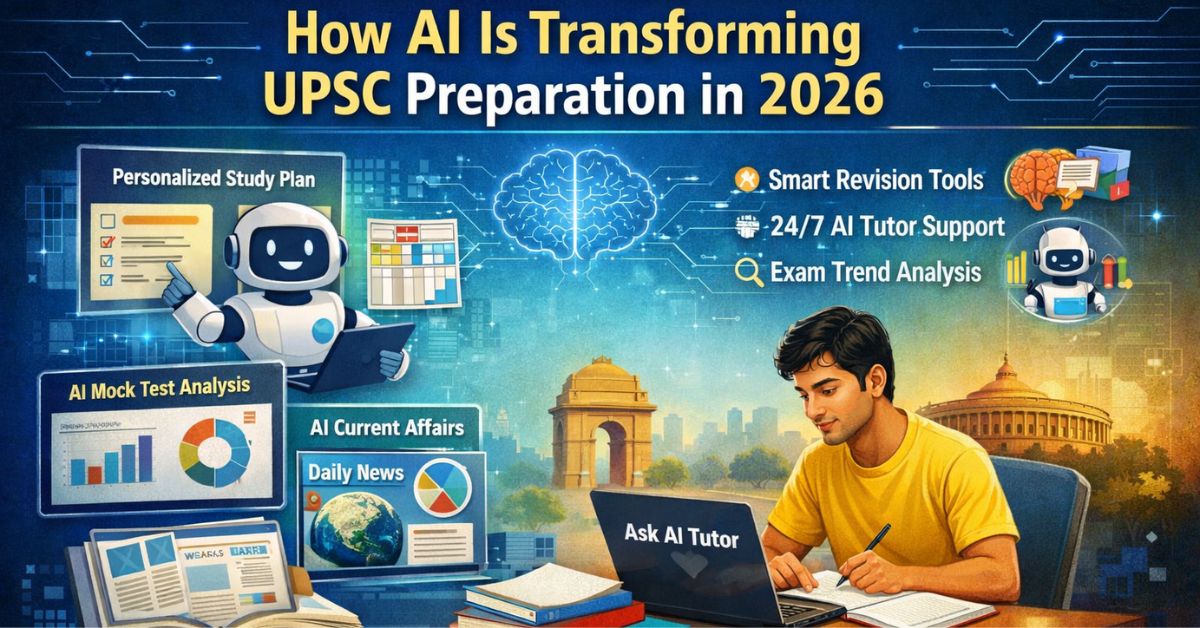
1. Personalized Study Plans Based on Aspirant Needs
One of the biggest challenges in UPSC preparation is knowing what to study and what to skip
AI-powered learning platforms now analyze:
- Your strengths and weaknesses
- Previous test performance
- Time availability
- Optional subject demands
Based on this data, AI creates customized daily and weekly study plans. Instead of following a generic timetable, aspirants now get tailor-made strategies, making preparation more efficient and less stressful.
2. Smart Analysis of Mock Tests & Answer Writing
Traditional mock tests only tell you how many marks you scored. AI goes much deeper.
AI-driven evaluation helps by:
- Identifying weak areas topic-wise
- Tracking improvement trends over time
- Analyzing answer structure, keywords, and relevance
- Suggesting model answers and improvements
For Mains answer writing, AI tools now provide instant feedback on:
- Introduction quality
- Logical flow
- Use of data, examples, and conclusions
This saves aspirants weeks of waiting for evaluations.
3. AI-Based Current Affairs Curation
Current affairs are the backbone of UPSC—but also the most time-consuming part.
AI tools now:
- Scan thousands of news sources daily
- Filter UPSC-relevant content
- Categorize news under GS Papers, Essay, and Optional subjects
- Link current events with static syllabus topics
This ensures aspirants study less but retain more, focusing only on what matters for the exam.
4. Intelligent Revision & Memory Enhancement
AI-driven revision tools use techniques like:
- Spaced repetition
- Active recall
- Adaptive quizzes
If you frequently forget Polity articles or Economic concepts, AI detects this pattern and automatically increases revision frequency for those topics. This scientific approach significantly improves long-term retention—crucial for Prelims and Mains.
5. Doubt Resolution Through AI Tutors
Instead of waiting for teachers or mentors, aspirants now use AI-powered virtual tutors available 24/7.
These AI tutors can:
- Explain complex concepts in simple language
- Provide examples from previous year questions
- Break down constitutional articles, economic terms, and case studies
- Answer doubts instantly, anytime
This is especially beneficial for working professionals and self-study aspirants.
6. Predictive Insights & Exam Trend Analysis
AI systems analyze:
- Previous year UPSC papers
- Topic frequency and weightage
- Emerging trends in questions
While AI cannot predict exact questions, it highlights high-probability areas, helping aspirants prioritize smartly without ignoring the syllabus.
7. Ethical Use of AI: A Word of Caution
While AI is a powerful tool, it should be used as a support system, not a shortcut.
Aspirants must remember:
- UPSC values originality and analytical thinking
- Overdependence on AI-generated answers can weaken conceptual clarity
- Human judgment, reading, and writing practice remain irreplaceable
The best results come when AI complements disciplined self-study, not replaces it.
The Future of UPSC Preparation Is Smart, Not Just Hard
In 2026, UPSC preparation is no longer about studying harder—it’s about studying smarter.
AI has democratized quality preparation by providing personalized guidance, instant feedback, and
structured learning paths.
Aspirants who learn to use AI wisely—while staying rooted in NCERTs, standard books, and
self-analysis—will gain a significant edge in this highly competitive exam.
The future civil servants of India will not just be well-read—they will be tech-aware, analytical, and
adaptive.