
Special Intensive Revision (SIR) of Electoral Rolls: Definition, Objectives, Significance, Challenges & Way Forward
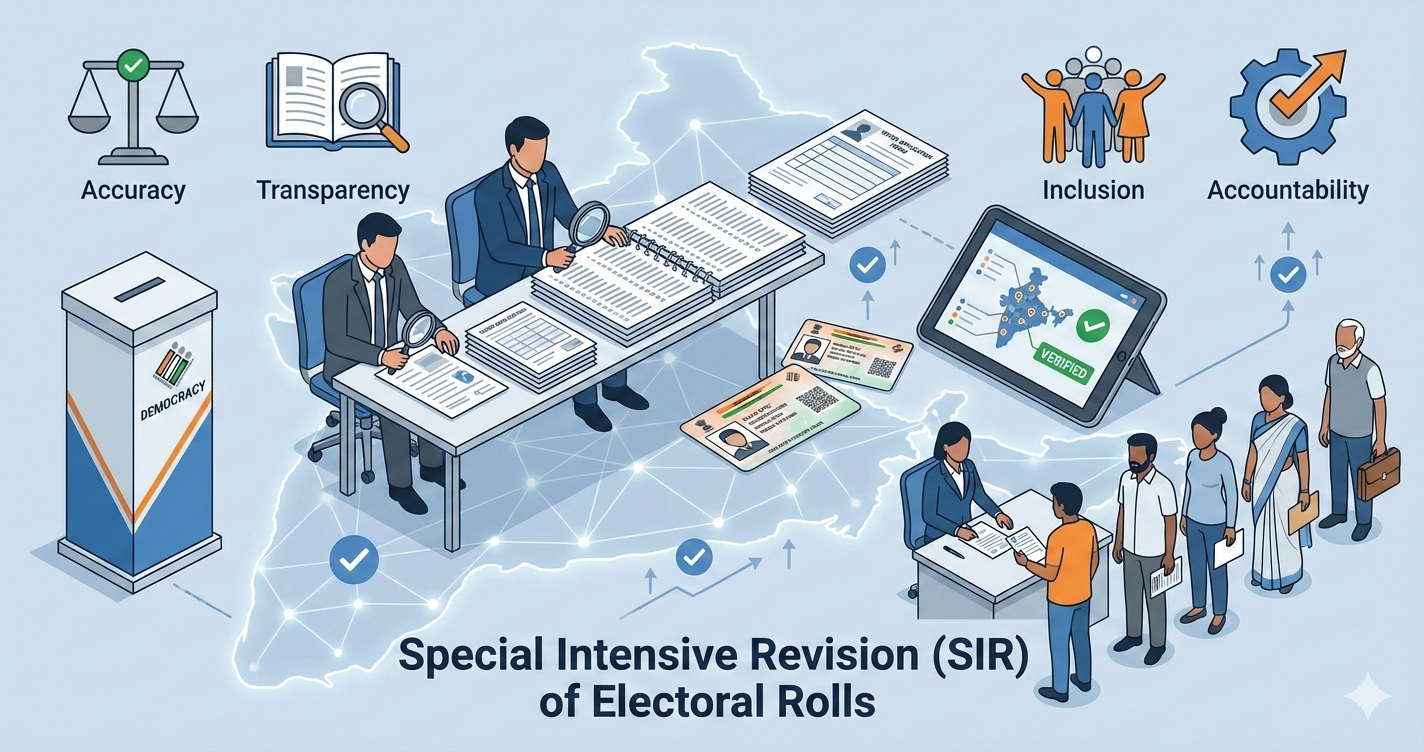
Free and fair elections form the cornerstone of any democratic system. In a country as large,
diverse, and mobile as India, maintaining accurate electoral rolls is a continuous challenge. To
address this, the Election Commission of India (ECI) periodically undertakes various forms of voter
list revisions. Among these, the Special Intensive Revision (SIR) of Electoral Rolls stands out as
the most comprehensive and rigorous exercise.
SIR aims to ensure that every eligible citizen is included and every ineligible entry is excluded,
thereby strengthening electoral integrity and public trust in democratic institutions.
Why Is Special Intensive Revision (SIR) in the News?
The Election Commission of India launched Special Intensive Revision (SIR) 2.0 on November 4, 2025,
across
12 States and Union Territories, covering more than 51 crore voters.
The exercise attracted nationwide attention after 65–68 lakh voters were deleted in Bihar, leading to
petitions in the Supreme Court of India. Concerns were raised regarding possible voter exclusion,
especially
of migrants, women, and marginalised communities. This triggered a broader debate on balancing electoral
roll purification with voter inclusion, making SIR a major constitutional and governance issue in 2025.
What Is Special Intensive Revision (SIR) of Electoral Rolls?
Special Intensive Revision (SIR) is a large-scale, comprehensive verification and update exercise conducted by the Election Commission to revise electoral rolls from the ground up.
Unlike routine or summary revisions, SIR involves:
- Fresh enumeration of voters
- Door-to-door verification
- Physical confirmation of eligibility and residence
The objective is to ensure that electoral rolls are accurate, inclusive, and free from duplicate, deceased, or ineligible voters.
Constitutional and Legal Basis of SIR
The authority to conduct SIR is firmly rooted in India’s constitutional and legal framework:
Constitutional Provisions
- Article 324: Grants the ECI powers of superintendence, direction, and control of elections, including voter list preparation.
- Article 326:Guarantees universal adult suffrage to all citizens aged 18 and above, subject to lawful disqualifications.
Statutory Provisions
- Representation of the People Act, 1950
- Section 21(3): Empowers the ECI to conduct special revision of electoral rolls at any time.
- Section 16: Disqualifies non-citizens from voter registration.
- Section 19: Defines voter eligibility based on age and ordinary residence.
- 20–24: Lay down procedures for claims, objections, and appeals.
Together, these provisions provide constitutional legitimacy and procedural safeguards to the SIR process.
Key Features of Special Intensive Revision
Some of the important features of SIR include:
- Applicable to citizens 18 years and above as on the qualifying date.
- Voters registered after January 2003 are required to submit documentary proof of:
- Date of birth
- Place of birth
- Parentage
- Booth Level Officers (BLOs) conduct house-to-house verification
- Distribution of pre-filled enumeration forms to voters.
- Identification and removal of:
- Duplicate registrations
- Deceased voters
- Shifted or non-resident voters
- Incorrect or fraudulent entries
Increasing use of digital tools, such as online portals, mobile apps, and SMS alerts, to improve transparency.
Objectives of Special Intensive Revision (SIR)
The overarching objective of SIR is to preserve the integrity of the electoral process.
Specific Objectives
- Verify whether registered voters continue to be eligible and ordinarily resident.
- Eliminate bogus voting and impersonation.
- Address challenges arising from urbanisation and internal migration.
- Ensure inclusion of first-time voters, especially youth.
- Correct long-standing errors accumulated over decades.
- Conduct fresh enumeration before major elections to ensure credible outcomes.
Step-by-Step Electoral Roll Revision Process Under SIR
The SIR process follows a systematic and participatory approach:
- House-to-house verification by Booth Level Officers
- Distribution and collection of enumeration forms.
- Verification of documents submitted by voters.
- Publication of draft electoral rolls.
- Period for claims and objections by citizens.
- Adjudication by Electoral Registration Officers.
- Disposal of appeals and corrections.
- Publication of the final electoral roll.
This multi-layered process is designed to ensure accuracy, transparency, and public participation.
Significance of Special Intensive Revision in Indian Democracy
1. Elimination of Ghost and Duplicate Voters
SIR helps remove fake and duplicate entries, improving the fairness of elections.
2. Addressing Migration
India witnesses large-scale rural-to-urban and inter-state migration. SIR updates voter lists to reflect current residence patterns.
3. Enhancing Voter Inclusion
Marginalised groups such as migrant workers, women, youth, and persons with disabilities benefit from fresh enumeration.
4. Improving Electoral Accuracy
Accurate electoral rolls ensure realistic voter turnout data and fair constituency representation.
5. Strengthening Democratic Trust
Transparent voter lists increase public confidence in the election process and democratic institutions.
Latest Developments in SIR (December 2025)
Due to ground-level challenges, the ECI extended deadlines for submission of enumeration forms:
- Tamil Nadu and Gujarat: till December 19, 2025
- Madhya Pradesh, Chhattisgarh, and Andaman & Nicobar Islands: till December 23, 2025
- Uttar Pradesh: till December 31, 2025
Final electoral rolls in Uttar Pradesh are scheduled for publication on February 28, 2026. Phase-2 of SIR affects over 51 crore voters, making it one of the largest electoral revision exercises in independent India.
Challenges Associated with Special Intensive Revision (SIR)
Despite its importance, SIR faces several challenges:
Documentation Barriers
Many poor, homeless, and illiterate citizens lack formal documents such as birth certificates or passports.
Migrant Voter Exclusion
Seasonal and informal workers often lack local address proof, leading to deletion from rolls.
Bihar Deletion Controversy
Large-scale voter deletions raised concerns of voter suppression and lack of transparency.
Gender Disparity
Reports indicated a higher deletion rate among women voters in some regions.
Minority Concerns
Allegations of disproportionate deletion of minority voters have led to fears of bias.
Digital Divide
Limited internet access and low digital literacy in rural areas restrict online participation.
Erosion of Trust
Perceived opacity in the process has affected public confidence in the Election Commission.
Role of the Supreme Court and Judicial Oversight
The Supreme Court acts as a crucial constitutional safeguard in the SIR process:
- Reviews the exercise under Article 32 when fundamental rights are alleged to be violated.
- Ensures compliance with Articles 14 and 326, protecting equality and voting rights.
- Provides corrective measures against arbitrary deletions through judicial review.
Judicial oversight ensures that SIR remains lawful, fair, and rights-based.
Way Forward: Making SIR More Inclusive and Effective
To balance electoral purity with voter inclusion, the following measures are essential:
- Simplify documentation requirements for vulnerable groups.
- Use self-declaration supported by local verification.
- Improve training, accountability, and workload management of BLOs.
- Strengthen grievance redressal and appeal mechanisms.
- Ensure timely publication of draft rolls and wide publicity.
- Use technology without excluding offline populations.
- Maintain transparency and continuous judicial oversight.
Conclusion
The Special Intensive Revision of Electoral Rolls is a vital tool for ensuring free, fair, and credible elections in India. However, its success depends not only on removing ineligible names but also on protecting the voting rights of genuine citizens.
A balanced, transparent, and inclusive approach to SIR can strengthen democratic institutions and uphold the constitutional promise of universal adult suffrage. As India continues to evolve socially and demographically, electoral reforms like SIR must adapt to ensure that no eligible voter is left behind.